
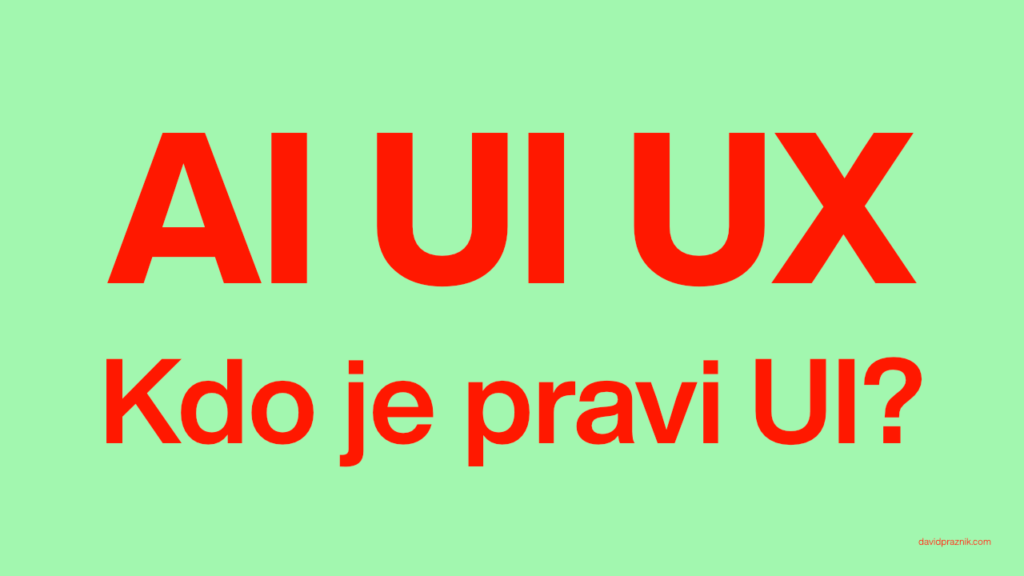
Translating acronyms in the UX/UI profession can be a thankless job. Some time ago, I wrote about it, why we had better not translate the abbreviation AI to UI. The abbreviation has (unfortunately) caught on in many places, thereby causing an additional problem.
A concrete example of confusion
Let us look at a concrete example. User Experience (UX) has a problem. The literal translation starts with I (izkušnja), so we get the same abbreviation UI as for artificial intelligence (umetna inteligenca). Thus, we have two completely different things, artificial intelligence (UI) and user experience (UI), with the same abbreviation. The sentence “we need UI research before designing the user interface” is now ambiguous: is it about artificial intelligence research or user experience research? The reader can only guess.
And as if that weren't enough, the user interface, which is inextricably linked to the user experience, doesn't even have its own established Slovene abbreviation. We could suggest UV (uporabniški vmesnik), but it isn't used in practice. So we have a single abbreviation, UI, for artificial intelligence and user experience, which are two different concepts. That leaves us with a third concept, the user interface, which is left without its own abbreviation. All three constantly intertwine in every UX/UI project.
A similar example is CX (Customer Experience). The translation is again “user experience”, the same as for UX, even though it is a broader, holistic concept that goes beyond the digital product alone and also includes contact with customer support, sales or the brand. The translation of acronyms is therefore not a problem confined to AI and UI, but is a recurring issue wherever English distinguishes between related concepts, whilst Slovenian inadvertently groups them together under the same umbrella.
This has led to total confusion, because the translation of acronyms is being done by halves. Some acronyms are translated, others are left alone, and there is no real rule. If we do decide to translate them, then it should be done consistently—all or nothing—as half-measures are worse than either.
Some abbreviations are not translated at all, as they are official standards. WCAG (Web Content Accessibility Guidelines) is one such example, where the official name of the standard remains in its original form in all languages, including Slovenian.
List of common abbreviations
The abbreviations in the list do not constitute a proposed rule, but are a snapshot of the current (chaotic) situation.
| English abbreviation | Meaning | Slovenian translation | Established Slovenian abbreviation |
|---|---|---|---|
| AI | Artificial Intelligence | artificial intelligence | UI |
| UI | User Interface | user interface | not established (suggestion: UV) |
| UX | User Experience | user experience | is not in use (duplicates UI) |
| CX | Customer Experience | user experience (in a broader, holistic sense) | nor established (additional conflict with UX) |
| IA | Information Architecture | information architecture | has not been implemented |
| IxD | Interaction Design | interaction design | has not been implemented |
| HCI | Human-Computer Interaction | human-computer interaction | has not been implemented |
| University of Texas | Usability Testing | usability testing | has not been implemented |
| A/B testing | A/B Testing | A/B testing | remains A/B |
| SUS | System Usability Scale | system usability scale | remains SUS |
| NPS | Net Promoter Score | Net Promoter Score | stay NPS |
| CSAT | Customer Satisfaction Score | user satisfaction rating | remains CSAT |
| DS | Design System | design system | has not been implemented |
| Call to Action | Call to Action | Call to action | Remaining CTA |
| WYSIWYG | What You See Is What You Get | what you see is what you get | remains WYSIWYG |
| WCAG | Web Content Accessibility Guidelines | guidelines for the accessibility of web content | remains WCAG |
| Accessibility | Accessibility | accessibility | remaining A11y |
| ARIA | Accessible Rich Internet Applications | remains ARIA | remains ARIA |
| CMS | Content Management System | content management system | has not been implemented |
| API | Application Programming Interface | remaining API | remaining API |
| MVP | Minimum Viable Product | the smallest feasible product | has not been implemented |
| SPA | Single-page application | spa hotel | spa hotel |
| CRO | Conversion Rate Optimisation | conversion rate optimisation | has not been implemented |
| KPI | Key Performance Indicator | key performance indicator | KKU (rarely used) |
| ROI | Return on Investment | return on investment | has not been implemented |
| B2B/B2C | Business-to-Business/Consumer | B2B/B2C remaining | B2B/B2C remaining |
| SaaS | Software as a Service | software as a service | remaining SaaS |
| SEO | Search Engine Optimisation | search engine optimisation | Remaining SEO |
The table above is not a solution, it is merely a snapshot of the current chaos. Translating acronyms is not a question of a better translation for UX or a new acronym for the user interface. It is a decision: do we translate consistently, applying a single rule to all acronyms, or do we leave them all alone?.
Until this decision on translating acronyms is made, UI will remain artificial intelligence, user experience and something in between, depending on who is writing the sentence.


